Defining “Delayed Mobilisation
Hello and welcome back.
If you’ve been following this series week by week, I hope you’re beginning to work alongside it—perhaps thinking through a research idea drawn from your own ward or clinical setting.
And if you’re a first-time reader, a quick question before we begin:
Are you working on a research question of your own as you read this?
This blog series isn’t meant to be read in isolation. Each post builds on the previous one, gradually developing a single clinical research question in the same way investigator-initiated research unfolds in real life. To get the most out of this series, I strongly recommend starting with Blog 1: https://www.rightresearchacademy.com/the-semmelweis-story/
Before moving further, let us briefly revisit the research question that anchors this entire series:
In elderly postoperative patients admitted to our ward, what postoperative clinical, functional, and system-related factors are associated with delayed mobilisation after surgery, when compared between patients with and without delayed mobilisation?
In clinical practice, we instinctively know what delayed mobilisation is. However, in research, “delayed mobilisation” cannot remain an intuitive or subjective concept. It must be defined in clear, observable, and measurable outcomes, so that it can be applied consistently across patients and assessed objectively.
If an outcome is poorly defined:
• Different investigators classify patients differently
• Results become inconsistent
• Comparisons across studies are impossible
Defining the outcome
Step 1: Start with how mobilisation is understood
Ask: What does mobilisation usually mean in clinical practice?
o Sitting at the edge of the bed?
o Standing with support?
o Walking a few steps?
Define mobilisation based on what is already done and recorded in routine care; otherwise, by enforcing ideal definitions or protocols, you stop observing reality and start creating it.
When you define mobilisation for your study, base it on what is actually recorded in everyday ward practice—not on textbook-perfect or guideline-level activities that are not consistently done or documented in real life.
For example:
• If nurses routinely document “sat on the chair” or “ambulated with support,” your definition should use those.
• If nobody routinely documents “walked 30 meters independently,” then using that as a definition creates a disconnect between concept and data.
If you use the latter, it ceases to be an observational study and becomes an experimental one. You are then:
• Imposing a specific mobilisation protocol
• Instructing staff to mobilise patients in a particular way
At this point:
• You are changing clinical behaviour
• You are altering exposure
• The study is no longer observational. It becomes interventional/experimental, even if unintentionally
Step 2: Choose the unit of measurement — time
Mobilisation is inherently a time-based event.
Commonly used measures include:
• Time from surgery to first sitting
• Time from surgery to first standing
• Time from surgery to first ambulation
For elderly postoperative patients, time to first standing or ambulation is often the most meaningful and functionally relevant.
Step 3: Decide what counts as “delayed”
This is the critical step. Delay must be defined a priori, not after looking at the data.
Typical options for this study are: time-based cut-offs or functional thresholds.
Time-based cut-offs (examples):
• Mobilisation within 24 hours
• Mobilisation within 48 hours
• Mobilisation within 72 hours
Cut-offs based on functional thresholds:
Delay defined as failure to achieve a minimum functional milestone:
• Not standing within X hours
• Not ambulating at least Y meters by day Z
This links outcome definition directly to patient function.
You should remember to factor in the type of surgery while defining the mobilisation time, because this will vary between procedures. We discussed in earlier blogs that outcome definition becomes easier when the ward admits patients from a single speciality. If postoperative patients from multiple specialities are admitted to the same ward, this definition becomes more challenging.
Type of outcome variable
Dichotomous vs continuous outcome
Binary outcome
• Yes / No
• Delayed / Not delayed
This approach is simpler and works well for cross-sectional studies, a commonly used observational design in investigator-initiated research. When delayed mobilisation is defined as a binary outcome, associations with postoperative clinical, functional, and system-related factors are typically examined using binary logistic regression, with results expressed as odds ratios and 95% confidence intervals.
Continuous outcome
• Time (in hours or days) to mobilisation
Although analysing time to mobilisation as a continuous variable preserves more information, it is not appropriate for this research question, where the objective is to identify factors associated with delayed versus non-delayed mobilisation.
If we were to use a continuous outcome, the question would need to be framed differently. One example would be: Which type of anaesthesia delays mobilisation—regional or general anaesthesia?
Thus, how we define the outcome determines which statistical analysis we should use.
Identifying exposure variables
Once the outcome has been clearly defined, the study can move forward. But an outcome alone cannot answer a research question. We now need to identify the exposures—the factors that may be associated with delayed mobilisation.
In observational research, exposures are not assigned or manipulated. They are observed characteristics or circumstances that already exist at the time the outcome occurs.
In our working research question, these exposures are broadly grouped as:
• Postoperative clinical factors
• Functional factors
• System-related factors
This categorisation is deliberate. It mirrors how clinicians think in real life—patient-related issues, functional readiness, and ward or system constraints.
What qualifies as an exposure?
An exposure must meet three basic criteria:
• It is present before the outcome occurs
• It can be measured or recorded reliably
• It varies across patients (for example, age, body weight, type of anaesthesia, presence of a catheter—something that is not the same for everyone)
Step 1: Start with what is routinely documented
Just as with outcomes, exposure variables should be drawn from what is already captured in routine clinical practice.
For elderly postoperative patients, commonly available sources include:
• Postoperative notes
• Nursing charts
• Medication records
• Anaesthesia records
• Physiotherapy notes
• Ward staffing or transfer logs
Using routinely documented data preserves the observational nature of the study and improves feasibility. Researchers are often ambitious in their ideas, but failing to pause and assess feasibility at each stage—before the study even begins—is one of the most frequent and preventable challenges in investigator-initiated research.
Step 2: Group exposures conceptually
Rather than listing dozens of variables randomly, exposures should be organised into logical domains.
1. Postoperative clinical factors
These reflect the patient’s immediate medical status after surgery.
Examples include:
• Type of surgery (major vs minor, abdominal vs orthopaedic)
• Type of anaesthesia (general vs regional)
• Postoperative pain severity
• Use of opioids or sedatives
• Presence of drains, catheters, or lines
• Postoperative complications (hypotension, nausea, delirium)
These factors directly influence a patient’s physiological readiness to mobilise.
2. Functional factors
These capture the patient’s physical capability and baseline reserve.
Examples include:
• Use of walking aids
• Muscle weakness or frailty indicators
• Cognitive impairment
• Fear of falling
• Postoperative dizziness or imbalance
Functional factors are particularly important in elderly populations, where physiological recovery alone does not guarantee mobilisation.
3. System-related factors
These are often overlooked but critically important.
Examples include:
• Availability of nursing staff
• Physiotherapy consultation delays
• Ward workload or patient-to-staff ratios
• Timing of surgery (weekday vs weekend)
• Delays in pain control orders
• Bed availability or transfers
System-related exposures do not reflect patient pathology, yet they frequently determine whether mobilisation occurs on time.
Step 3: Define exposures clearly and simply
Each exposure must be operationalised in a way that is:
• Unambiguous
• Reproducible
• Consistent across patients
For example:
• “High pain” should be defined using a pain score threshold
• “Delay in physiotherapy” should be defined as referral after a specific time window
• “Use of opioids” should specify drug class or duration
Vague labels such as “poor pain control” or “inadequate staffing” should be avoided unless they are converted into measurable definitions.
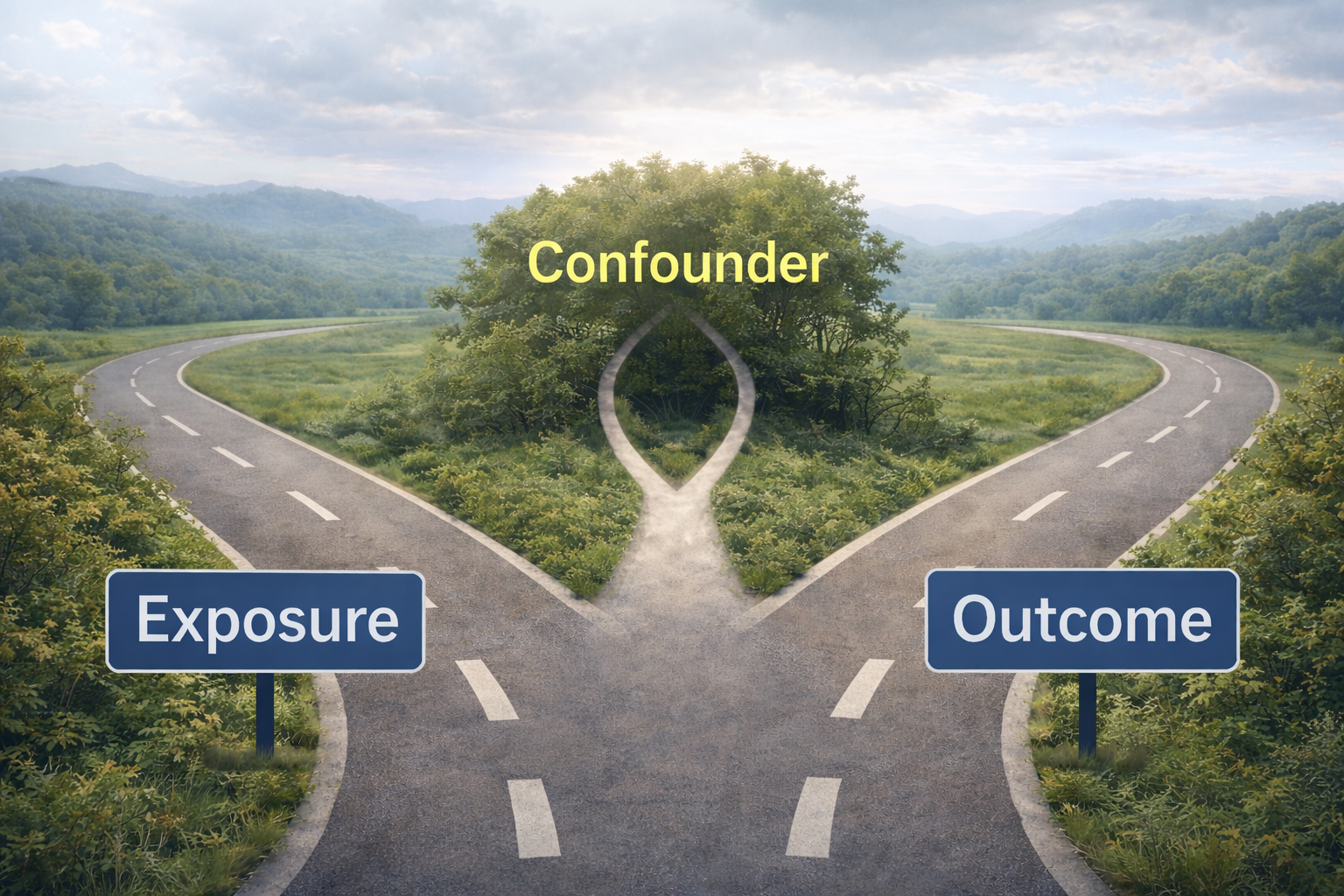
Step 4: Anticipate confounding early
In observational studies, exposures do not exist in isolation.
For example:
• Patients undergoing major surgery are more likely to receive general anaesthesia
• Frailer patients may receive more opioids
• Higher-dependency patients may be admitted on weekends
These interrelationships create confounding, where the observed association between an exposure and delayed mobilisation may be influenced by another variable.
Recognising potential confounders at the exposure-definition stage allows for:
• Thoughtful data collection
• Appropriate multivariable analysis later
Bringing it together
At this stage of the study:
• The outcome has been clearly defined
• The exposure domains have been identified
• Variables are chosen based on clinical logic and feasibility
Only now is the study ready to move into analysis planning.
In the next blogs, we will build on this foundation to explore:
• How exposures are analysed against a binary outcome
• How confounding is handled using regression models
• How to interpret associations responsibly in observational research
Before we move on, pause and reflect:
Can you list one outcome and at least three exposures from your own research idea? If you haven’t done it yet, take five minutes now and write them down—because working on your own question alongside this series is where the real learning happens.