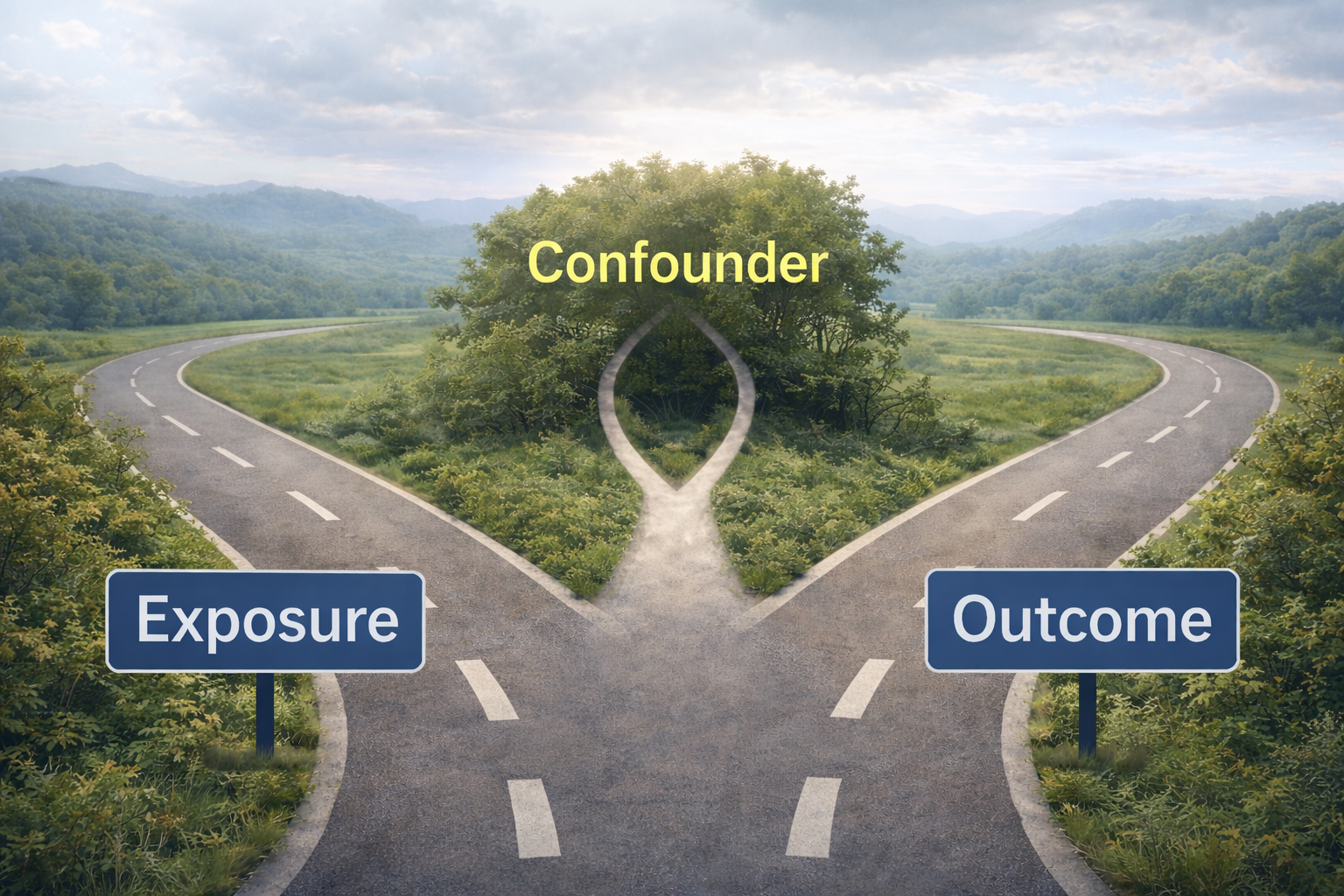
Letting the Question Choose the Study
Now that we have sharpened our research question, it is time to move ahead and decide which study design we will use.
Each study design is a different game, with its own rules. The choice we make will determine which variables we collect, how we compare groups, what analyses are possible, and—most importantly—what conclusions we are allowed to draw.
Here is the question that we chose:
In elderly postoperative patients admitted to our ward, what postoperative clinical, functional, and system-related factors are associated with delayed mobilisation after surgery, when compared between patients with and without delayed mobilisation?
The next step is critical:
What study design can realistically answer this question?
The question itself hints at the design. Look closely at how this question is framed.
We are not asking:
Instead, we are asking:
The comparison is natural, not imposed:
The exposures are existing characteristics, not interventions:
Emphasis is on association, not causation.
Without explicitly saying so, the question is already pointing us toward an observational approach.
Could this question be answered using an interventional design?
In theory, yes. One could design a study where elderly postoperative patients are assigned to different mobilisation strategies But this would transform the question into something else entirely:
For a clinician planning their own study, especially within a busy hospital ward—this change is not a small one. Moving from observation to intervention means altering routine care, obtaining broader approvals, and coordinating with multiple teams, which is often difficult in day-to-day clinical practice.
The current question is diagnostic and exploratory, not prescriptive.
Feasibility: the silent gatekeeper of study design
Before committing to any design, every investigator-initiated study must pass through a practical filter:
Can this study be done in my setting, with the resources and authority I have?
In this case:
This makes the study:
Strengths of an observational approach for this question
Most importantly, it answers the right question at the right stage.
Understand the limitations of an observational study
We have chosen an appropriate design for our question but we should know what we can expect and what not to expect from the study.
Observational studies cannot prove causation.
They can, however:
Why the rest of this series focuses on observational studies
In busy hospital wards, most clinician-led research begins as observational and often stays that way. This reflects clinical reality, not a lack of ambition.
If you think back to Semmelweis, his first step was observational. He studied hospital records, compared outcomes, and identified associations. This allowed him to recognise a high-risk group and uncover a modifiable factor—hand hygiene.
Observational thinking came first.
Intervention followed later.
In the blogs ahead, we will unpack:
So, we have chosen an observational approach. But “observational study” is not a single design—it is a family of designs.
In the next blog, we will break this down further:
What kinds of observational studies are available, and how do you choose the right one for your question? The real precision comes from choosing the right observational design.